If you want to find arguments for setting up a project management office (PMO), this will probably be easy at first. You are aiming to economize by making project handling more efficient and successful. It becomes more complicated once you must prove that a PMO is actually profitable for the company. But how do you create key performance indicators in project management in the form of PMO KPIs? How do you measure its value? And its acceptance?
In this article, you will learn how to go about creating PMO KPIs or key performance indicators in project management and what to pay attention to:
- PMOs must have a measurable effect
- PMO KPIs – How to prove the PMO value
- What you should take into account when measuring PMO KPIs
- How to introduce project management KPIs
- Conclusion: PMO KPIs & key performance indicators in project management
Let us get started.
PMOs Must Have a Measurable Effect
Often the PMO’s share in the company’s success is neither measured nor communicated sufficiently. This can lead to the perception that PMOs are not benefitting the company noticeably, if at all.
To find out about the state of the PMO, we conducted an in-depth PMO survey in Germany, Austria and Switzerland in 2020. We surveyed 588 individuals from 450 different companies, 73% of which already had a PMO.
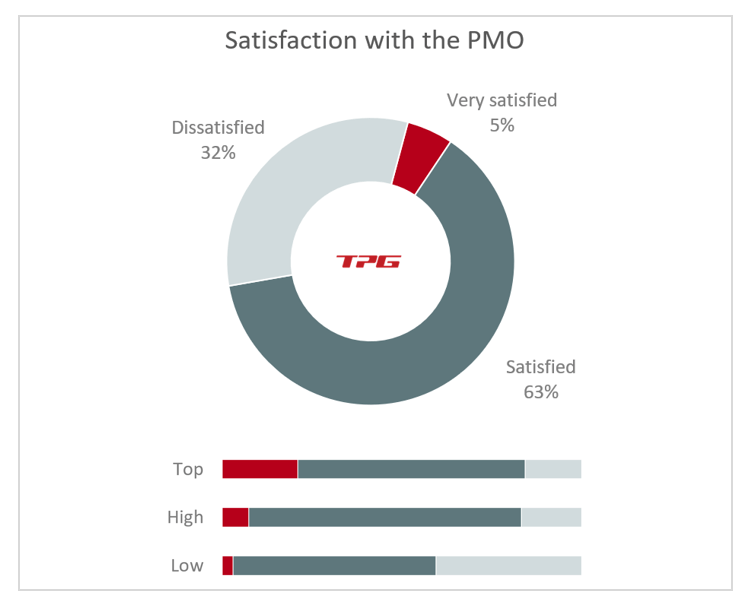
We asked them to rate their satisfaction with the PMO. Only 5% of the participants were very satisfied. The majority (63%) was satisfied but saw minimal need for improvement. The remaining 32% were dissatisfied and wished to see significant improvements.
In our study, we also divided the respondents into three groups depending on their performance level, i.e. low performers, high performers and top performers. We assigned the companies to the groups according to their responses to questions regarding compliance with deadlines, budgets and quality requirements.
Among the top performers, the proportion of “very satisfied” respondents was much higher (20%). They were three times as satisfied as high performers and seven times as satisfied as low performers.
The survey arrived at another interesting conclusion. It appears that the longer the PMO has existed, the greater the positive influence on the companies’ project management. Top performers were most likely to have had their PMO for more than five years.
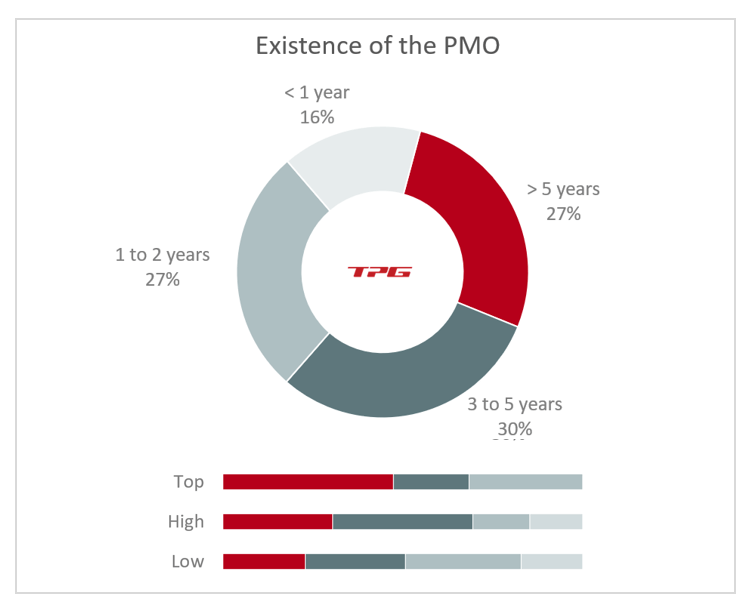
Satisfaction with the PMO is directly related to the PMO’s ability to successfully manage projects, how long the PMO has been in existence, and the number of PMO employees.
PMO Study 2020: Part 1, p. 21
Can this feeling of having a highly beneficial PMO actually be measured using KPIs for PMO? And can the value be attested? This article demonstrates how you can assess the benefits provided by your PMO with KPIs.
The results should enable you to make the right improvements and thereby increase the lifespan and performance of your PMO.
PMO KPIs – How to Prove the PMO Value
A Key Performance Indicator (KPI) is an index reflecting the success, or rather the performance, of an organizational unit such as a PMO.
Looking to successfully set up a PMO? Check out our detailed guide!
To prove the value provided by your PMO, you should:
- Define a set of key project performance indicators (PMO KPIs).
- Align these with your stakeholders.
This is likely to increase your chance of a long-lasting existence.
Below, you will find qualitative and quantitative topics for measuring the additional value. You can use them as a basis for your assessment process. Essentially, you can distinguish three areas for the project management office:
- The work of the PMO
- The acceptance of the PMO
- The results affected by the PMO
1) The Work of the PMO
The chart below shows how to take quantitative measurements regarding your PMO’s work and maturity level. All PMO KPI examples allow measuring – and thus can substantiate the development and the success of the PMO.
Areas for the measurable quantities allowing for KPI mapping are:
- Completeness of lists, reports, etc. (projects and reports consistently available?)
- Currency of data, reports, etc. (all project updated within the timeframe?)
- Training level of the employees (training completed?)
- Support by the PMO (no ticket open longer than agreed?)
- Stakeholder acceptance of the PMO (survey with good results?)
- Establishment and documentation of the method (documentation complete and available?)
Let us use the list of active projects as an example. Your company currently has 100 active projects, but only 80 are recorded on the project list. Some of them may be missing values for traffic light indicators, cost, etc. In addition, more than half of them may have a status report older than 4 weeks.
Read about the importance of meaningful and up-to-date project status reports
Thus, you have a measurable need for improvement.
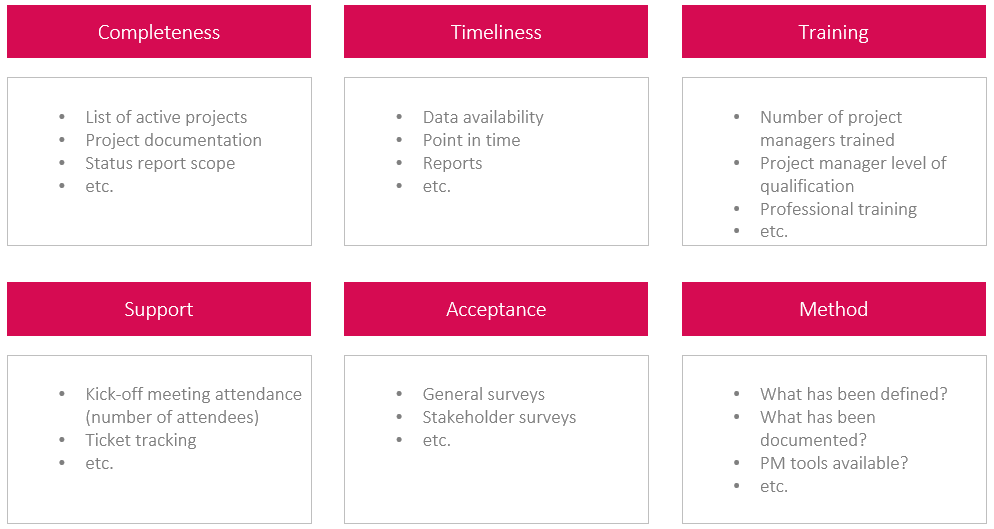
You should be able to judge most topics by assessing the current stock of data.
2) The Acceptance of the PMO
The PMO’s acceptance is a different thing altogether. The only way to find out how the work of the PMO is actually viewed are repeated surveys of the stakeholders.
You could ask the following questions:
- Overall, are you satisfied with the service of the PMO?
- Are you happy to use the services of the PMO?
- Do you consider the PMO’s response time adequate?
- Does the PMO save you time?
- Does the PMO provide assistance to you?
- Do you find out about priorities in the portfolio?
- Do you feel the PMO supports you in the case of resource conflicts?
- Do you find the specified PM methods useful?
- Is the PM documentation sufficient?
- Is the training provided helpful?
3) The Results Affected by the PMO
If a PMO’s work is successful, it will also contribute to corporate success. However, this circumstance is harder to measure than the topics presented above. This is about measuring the effects. Often, the latter can only be noticed indirectly.
For instance, increasing the project output could be a desirable goal. It will be easy for you to determine the number of successfully completed projects in a portfolio, e.g. per year.
Yet, such a number can only be of limited value. This is due to the differences between the projects (complexity, duration, effort, cost …). Always bear this in mind!
In our PMO survey mentioned above, we differentiated between the quantitative and the qualitative assessment of the benefits of the PMO.
For the quantitative assessment, we asked the question “Which of the following project-related data do you use to determine the quantitative benefit provided by your PMO?”
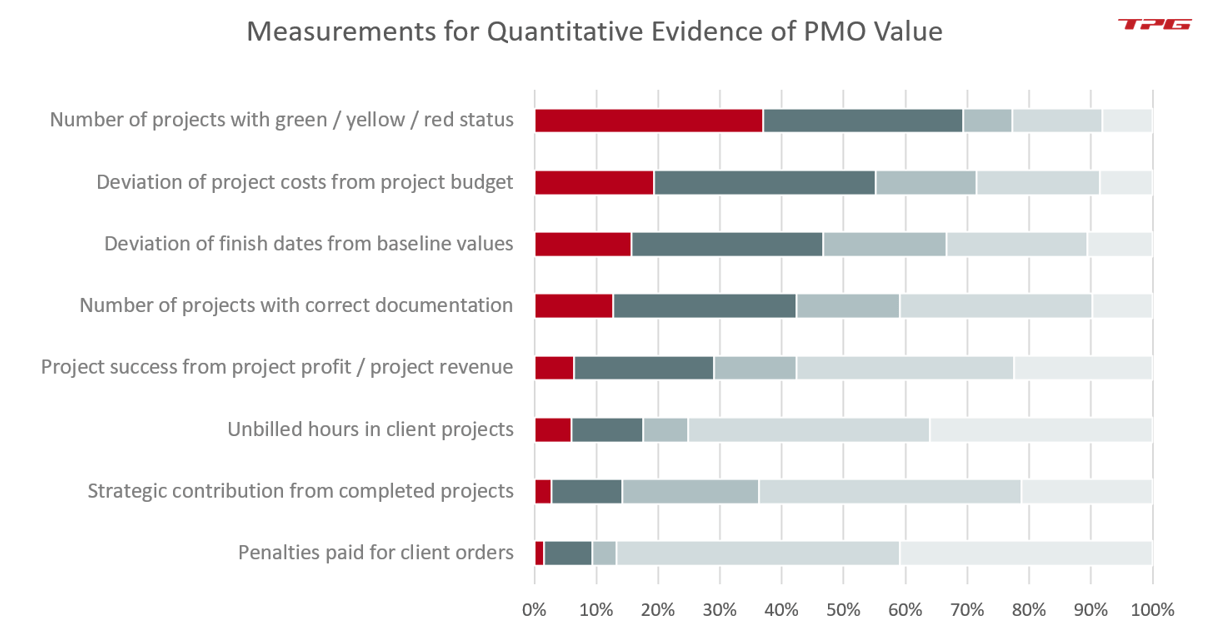
Questions you could assess in this context include:
- What is the number of projects with green / yellow / red status?
- How far do project costs deviate from the respective project budget?
- To what extent do project finish dates vary from the related baseline values?
- What is the number of projects with correct documentation?
- What was the project success from project profit / project revenue?
- What is the number of unbilled hours in client projects?
- What has been the strategic contribution of completed projects?
- How high / many were the penalties paid for client orders?
Measurements of the quantitative benefit are more widespread among companies, as these are easier to measure than the qualitative benefits. Our PMO study also found that high performers were far ahead of low performers in taking quantitative measurements.
Still, measuring the qualitative benefits is also valuable. In our PMO survey, we asked the respondents whether they regularly surveyed the stakeholders with this purpose. Again, top and high performers were ahead of low performers when it came to taking these measurements.
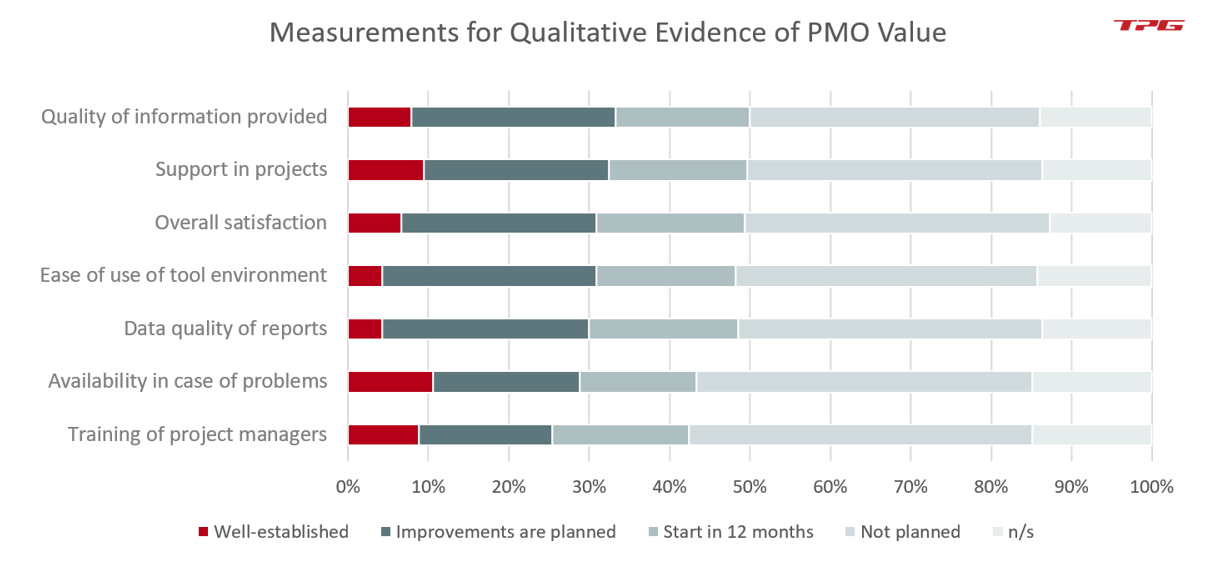
For the stakeholder survey aiming for qualitative evidence, we propose questions regarding different topics. For example:
- How would you rate the quality of the information provided by the PMO?
- Does the PMO provide helpful support in projects?
- How would you rate your overall satisfaction with the PMO?
- Is the tool environment easy to use?
- What is your impression of the data quality of the reports?
- How is the PMO’s general availability in the event of a problem?
- Does the PMO provide good training and staff development measures?
Reading tip: ROI Calculation for PPM Tools: Making Informed Decisions
A 2013/2014 PMO study by the German Association for Project Management (Deutsche Gesellschaft für Projektmanagement, GPM) dealt explicitly with the assessment of PMO success. The study listed five areas to measure if you want to determine a PMO’s success:
- How well do people follow the defined project management process?
- How high is the level of target achievement for the projects in the portfolio?
- How well can you control the project portfolio (level of controllability)?
- What is the feasibility of the planned project portfolio?
- How good is the maturity level of projects in the planned portfolio?
Special Download: How to set up a PMO in 4 simple steps (PDF file)
Please fill in the form.
* Required Fields | Data Protection
What You Should Take into Account When Measuring PMO KPIs
Note that there is one essential prerequisite for measuring improvements. Record the initial state. Document it by all means to allow you to compare states later on.
Regular measurements will ensure you can document the changes based on this. The recorded initial state will also permit you to demonstrate the developments. In addition, it is an important basis for determining the maturity level.
PMO members can either conduct surveys and measurements themselves or via external PMO consulting. With external support, you will increase the acceptance of the survey results within the company. After all, there will be no self-evaluation by the PMO.
Special Download (PDF): What are typical PMO functions? (+ their importance)
This article provides you with a good comparison as well as ideas for functions you could consider next for your PMO. Please fill in the form to download.
* Required Fields | Data Protection
How to Introduce Project Management KPIs for PMO
To measure success in your PMO or project management, proceed as follows:
Pick those key performance indicators from the list above which you consider relevant for your needs.
Next, you should align this selection with your stakeholders. At the same time, you need to settle how often you are going to report the current values of these indicators.
Over time, the PMO’s area of responsibility will also change. This will be due to corresponding changes in maturity level and targets. One thing you should be prepared for: defining the assessment process will not be a one-off.
By determining the topics for evaluation, it often becomes easier to define the task field.
Make the results of evaluation or surveys available to all employees – preferably in the PMO portal. Make no secret of it.
Take countermeasures if a development in the wrong direction becomes apparent.
Document the measures you plan and take so that the PMO comes across as active and transparent.
Your project environment is sure to be dynamic. The PMO cannot be seen to lag behind. Create an awareness of the PMO value by regular and active reporting.
Celebrate project successes. And get positive statements from project managers and other stakeholders stating how they profited from the PMO.
Conclusion – How to Create PMO KPIs & Key Performance Indicators in Project Management
This article has shown that the PMO value cannot be determined with a single method alone. Rather, it is necessary to take into account the individual PMO responsibilities in your company.
We have listed suggestions for measuring the individual additional value of your PMO. You have also learned what to keep in mind when measuring. In this case, the measurable quantities are:
- Work
- PMO acceptance
- Results affected by the PMO
Out of these, you should put together an assessment process appropriate for your environment.
Our final tips
Get to know the individually adaptable “PPM Paradise” – the optimal environment for your enterprise-wide project, program, portfolio and resource management. Download the eBook now (just click, no form).
And sign up for our bi-weekly blog newsletter to make sure you receive all our updates.
Did you like this article? What is your approach to demonstrating the value and acceptance of your PMO? Please use the comment area below.
Subscribe to TPG BlogInfo: Never miss new practice-oriented tips & tricks
Every other week: Receive practical tips in TPG blog posts written by recognized experts in project, portfolio, and resource management.
* Required Fields | Data Protection
Managing Partner at TPG

The certified engineer, has been a managing partner at TPG The Project Group since 2001. After many years as a development engineer in the automotive and energy sectors, Johann Strasser spent a decade as an independent trainer and consultant in the field of project management. During his tenure, he also served as project manager for software projects in the construction industry and provided scheduling and cost management support for large-scale construction projects. At TPG, he applies his expertise in product development and consulting services for international clients. His special focus is on PMO, project portfolios, hybrid project management, and resource management. For many years now, he has shared his knowledge through presentations, seminars, articles, and webinars.
Read more about Johann Strasser on LinkedIn and XING.
Senior Marketing Manager

After earning his engineering degree in environmental technology, he gained many years of experience in project management through his work at an engineering office, an equipment manufacturer, and a multimedia agency. Achim Schmidt-Sibeth and his team have been responsible for marketing and communication at TPG The Project Group for many years now.